- Sku
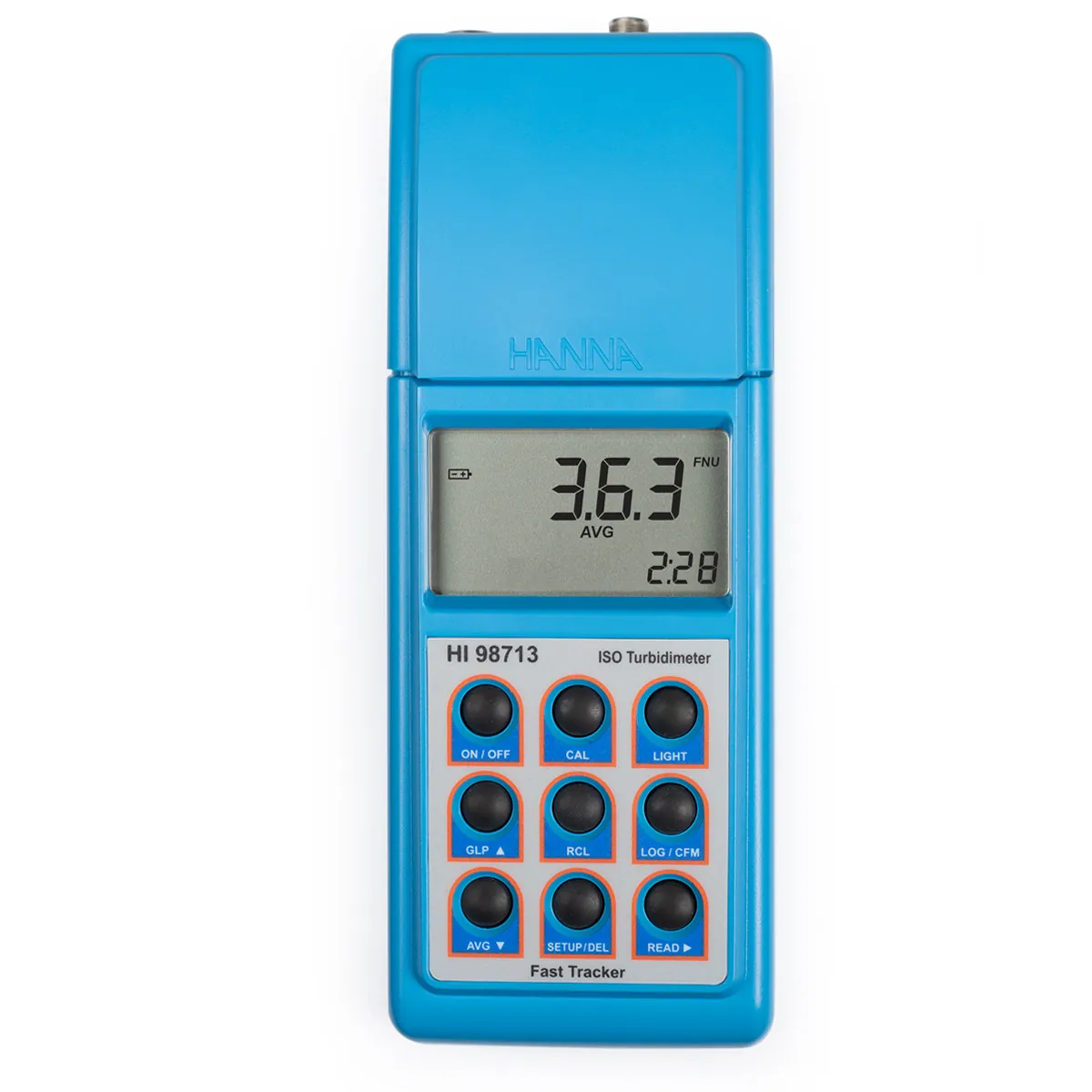
- HI98713-01 FNU Range 0.00 to 9.99 FNU 10.0 to 99.9 FNU 100 to 1000 FNU FNU Resolution 0.01 FNU from 0.00 to 9.99 FNU 0.1 FNU from 10.0 to 99.9 FNU 1 FNU from 100 to 1000 FNU FNU Accuracy ±2% of reading plus 0.1 FNU Range Selection Automatic Turbidity Repeatability ±1% of reading or 0.01 FNU, whichever is greater Stray Light < 0.1 FNU Typical EMC Deviation ±0.05 FNU Turbidity Light Detector 860 nm infrared LED IR Detector Silicon Photocell Turbidity Method Adaptation of ISO 7027, ratio method with 90° and 180° detector. Turbidity Standards < 0.1, 15, 100 and 750 FNU Calibration Two, three or four point calibration Display 60 x 90 mm LCD with backlight LOG Memory 200 records Serial Interface RS232 and USB 1.1 Environment 0 to 50°C (32 to 122°F) max 95% RH non-condensing Power Supply 4 x 1.5V AA alkaline batteries or AC adapter Auto Shut-Off After 15 minutes of non-use Dimensions 224 x 87 x 77 mm (8.8 x 3.4 x 3.0in.) Weight 512 g (18 oz.) Warranty 2 years
- Weight
- 512 g (18 oz.) Warranty 2 years
- Display
- 60 x 90 mm LCD with backlight LOG Memory 200 records Serial Interface RS232 and USB 1.1 Environment 0 to 50°C (32 to 122°F) max 95% RH non-condensing Power Supply 4 x 1.5V AA alkaline batteries or AC adapter Auto Shut-Off After 15 minutes of non-use Dimensions 224 x 87 x 77 mm (8.8 x 3.4 x 3.0in.) Weight 512 g (18 oz.) Warranty 2 years
- Warranty
- 2 years
- FNU Range
- 0.00 to 9.99 FNU 10.0 to 99.9 FNU 100 to 1000 FNU FNU Resolution 0.01 FNU from 0.00 to 9.99 FNU 0.1 FNU from 10.0 to 99.9 FNU 1 FNU from 100 to 1000 FNU FNU Accuracy ±2% of reading plus 0.1 FNU Range Selection Automatic Turbidity Repeatability ±1% of reading or 0.01 FNU, whichever is greater Stray Light < 0.1 FNU Typical EMC Deviation ±0.05 FNU Turbidity Light Detector 860 nm infrared LED IR Detector Silicon Photocell Turbidity Method Adaptation of ISO 7027, ratio method with 90° and 180° detector. Turbidity Standards < 0.1, 15, 100 and 750 FNU Calibration Two, three or four point calibration Display 60 x 90 mm LCD with backlight LOG Memory 200 records Serial Interface RS232 and USB 1.1 Environment 0 to 50°C (32 to 122°F) max 95% RH non-condensing Power Supply 4 x 1.5V AA alkaline batteries or AC adapter Auto Shut-Off After 15 minutes of non-use Dimensions 224 x 87 x 77 mm (8.8 x 3.4 x 3.0in.) Weight 512 g (18 oz.) Warranty 2 years
- Dimensions
- 224 x 87 x 77 mm (8.8 x 3.4 x 3.0in.) Weight 512 g (18 oz.) Warranty 2 years
- LOG Memory
- 200 records Serial Interface RS232 and USB 1.1 Environment 0 to 50°C (32 to 122°F) max 95% RH non-condensing Power Supply 4 x 1.5V AA alkaline batteries or AC adapter Auto Shut-Off After 15 minutes of non-use Dimensions 224 x 87 x 77 mm (8.8 x 3.4 x 3.0in.) Weight 512 g (18 oz.) Warranty 2 years
- Calibration
- Two, three or four point calibration Display 60 x 90 mm LCD with backlight LOG Memory 200 records Serial Interface RS232 and USB 1.1 Environment 0 to 50°C (32 to 122°F) max 95% RH non-condensing Power Supply 4 x 1.5V AA alkaline batteries or AC adapter Auto Shut-Off After 15 minutes of non-use Dimensions 224 x 87 x 77 mm (8.8 x 3.4 x 3.0in.) Weight 512 g (18 oz.) Warranty 2 years
- Environment
- 0 to 50°C (32 to 122°F) max 95% RH non-condensing Power Supply 4 x 1.5V AA alkaline batteries or AC adapter Auto Shut-Off After 15 minutes of non-use Dimensions 224 x 87 x 77 mm (8.8 x 3.4 x 3.0in.) Weight 512 g (18 oz.) Warranty 2 years
- IR Detector
- Silicon Photocell Turbidity Method Adaptation of ISO 7027, ratio method with 90° and 180° detector. Turbidity Standards < 0.1, 15, 100 and 750 FNU Calibration Two, three or four point calibration Display 60 x 90 mm LCD with backlight LOG Memory 200 records Serial Interface RS232 and USB 1.1 Environment 0 to 50°C (32 to 122°F) max 95% RH non-condensing Power Supply 4 x 1.5V AA alkaline batteries or AC adapter Auto Shut-Off After 15 minutes of non-use Dimensions 224 x 87 x 77 mm (8.8 x 3.4 x 3.0in.) Weight 512 g (18 oz.) Warranty 2 years
- Stray Light
- < 0.1 FNU Typical EMC Deviation ±0.05 FNU Turbidity Light Detector 860 nm infrared LED IR Detector Silicon Photocell Turbidity Method Adaptation of ISO 7027, ratio method with 90° and 180° detector. Turbidity Standards < 0.1, 15, 100 and 750 FNU Calibration Two, three or four point calibration Display 60 x 90 mm LCD with backlight LOG Memory 200 records Serial Interface RS232 and USB 1.1 Environment 0 to 50°C (32 to 122°F) max 95% RH non-condensing Power Supply 4 x 1.5V AA alkaline batteries or AC adapter Auto Shut-Off After 15 minutes of non-use Dimensions 224 x 87 x 77 mm (8.8 x 3.4 x 3.0in.) Weight 512 g (18 oz.) Warranty 2 years
- FNU Accuracy
- ±2% of reading plus 0.1 FNU Range Selection Automatic Turbidity Repeatability ±1% of reading or 0.01 FNU, whichever is greater Stray Light < 0.1 FNU Typical EMC Deviation ±0.05 FNU Turbidity Light Detector 860 nm infrared LED IR Detector Silicon Photocell Turbidity Method Adaptation of ISO 7027, ratio method with 90° and 180° detector. Turbidity Standards < 0.1, 15, 100 and 750 FNU Calibration Two, three or four point calibration Display 60 x 90 mm LCD with backlight LOG Memory 200 records Serial Interface RS232 and USB 1.1 Environment 0 to 50°C (32 to 122°F) max 95% RH non-condensing Power Supply 4 x 1.5V AA alkaline batteries or AC adapter Auto Shut-Off After 15 minutes of non-use Dimensions 224 x 87 x 77 mm (8.8 x 3.4 x 3.0in.) Weight 512 g (18 oz.) Warranty 2 years
- Power Supply
- 4 x 1.5V AA alkaline batteries or AC adapter Auto Shut-Off After 15 minutes of non-use Dimensions 224 x 87 x 77 mm (8.8 x 3.4 x 3.0in.) Weight 512 g (18 oz.) Warranty 2 years
- Auto Shut Off
- After 15 minutes of non-use Dimensions 224 x 87 x 77 mm (8.8 x 3.4 x 3.0in.) Weight 512 g (18 oz.) Warranty 2 years
- FNU Resolution
- 0.01 FNU from 0.00 to 9.99 FNU 0.1 FNU from 10.0 to 99.9 FNU 1 FNU from 100 to 1000 FNU FNU Accuracy ±2% of reading plus 0.1 FNU Range Selection Automatic Turbidity Repeatability ±1% of reading or 0.01 FNU, whichever is greater Stray Light < 0.1 FNU Typical EMC Deviation ±0.05 FNU Turbidity Light Detector 860 nm infrared LED IR Detector Silicon Photocell Turbidity Method Adaptation of ISO 7027, ratio method with 90° and 180° detector. Turbidity Standards < 0.1, 15, 100 and 750 FNU Calibration Two, three or four point calibration Display 60 x 90 mm LCD with backlight LOG Memory 200 records Serial Interface RS232 and USB 1.1 Environment 0 to 50°C (32 to 122°F) max 95% RH non-condensing Power Supply 4 x 1.5V AA alkaline batteries or AC adapter Auto Shut-Off After 15 minutes of non-use Dimensions 224 x 87 x 77 mm (8.8 x 3.4 x 3.0in.) Weight 512 g (18 oz.) Warranty 2 years
- Range Selection
- Automatic Turbidity Repeatability ±1% of reading or 0.01 FNU, whichever is greater Stray Light < 0.1 FNU Typical EMC Deviation ±0.05 FNU Turbidity Light Detector 860 nm infrared LED IR Detector Silicon Photocell Turbidity Method Adaptation of ISO 7027, ratio method with 90° and 180° detector. Turbidity Standards < 0.1, 15, 100 and 750 FNU Calibration Two, three or four point calibration Display 60 x 90 mm LCD with backlight LOG Memory 200 records Serial Interface RS232 and USB 1.1 Environment 0 to 50°C (32 to 122°F) max 95% RH non-condensing Power Supply 4 x 1.5V AA alkaline batteries or AC adapter Auto Shut-Off After 15 minutes of non-use Dimensions 224 x 87 x 77 mm (8.8 x 3.4 x 3.0in.) Weight 512 g (18 oz.) Warranty 2 years
- Serial Interface
- RS232 and USB 1.1 Environment 0 to 50°C (32 to 122°F) max 95% RH non-condensing Power Supply 4 x 1.5V AA alkaline batteries or AC adapter Auto Shut-Off After 15 minutes of non-use Dimensions 224 x 87 x 77 mm (8.8 x 3.4 x 3.0in.) Weight 512 g (18 oz.) Warranty 2 years
- Turbidity Method
- Adaptation of ISO 7027, ratio method with 90° and 180° detector. Turbidity Standards < 0.1, 15, 100 and 750 FNU Calibration Two, three or four point calibration Display 60 x 90 mm LCD with backlight LOG Memory 200 records Serial Interface RS232 and USB 1.1 Environment 0 to 50°C (32 to 122°F) max 95% RH non-condensing Power Supply 4 x 1.5V AA alkaline batteries or AC adapter Auto Shut-Off After 15 minutes of non-use Dimensions 224 x 87 x 77 mm (8.8 x 3.4 x 3.0in.) Weight 512 g (18 oz.) Warranty 2 years
- Turbidity Standards
- < 0.1, 15, 100 and 750 FNU Calibration Two, three or four point calibration Display 60 x 90 mm LCD with backlight LOG Memory 200 records Serial Interface RS232 and USB 1.1 Environment 0 to 50°C (32 to 122°F) max 95% RH non-condensing Power Supply 4 x 1.5V AA alkaline batteries or AC adapter Auto Shut-Off After 15 minutes of non-use Dimensions 224 x 87 x 77 mm (8.8 x 3.4 x 3.0in.) Weight 512 g (18 oz.) Warranty 2 years
- Typical EMC Deviation
- ±0.05 FNU Turbidity Light Detector 860 nm infrared LED IR Detector Silicon Photocell Turbidity Method Adaptation of ISO 7027, ratio method with 90° and 180° detector. Turbidity Standards < 0.1, 15, 100 and 750 FNU Calibration Two, three or four point calibration Display 60 x 90 mm LCD with backlight LOG Memory 200 records Serial Interface RS232 and USB 1.1 Environment 0 to 50°C (32 to 122°F) max 95% RH non-condensing Power Supply 4 x 1.5V AA alkaline batteries or AC adapter Auto Shut-Off After 15 minutes of non-use Dimensions 224 x 87 x 77 mm (8.8 x 3.4 x 3.0in.) Weight 512 g (18 oz.) Warranty 2 years
- Turbidity Repeatability
- ±1% of reading or 0.01 FNU, whichever is greater Stray Light < 0.1 FNU Typical EMC Deviation ±0.05 FNU Turbidity Light Detector 860 nm infrared LED IR Detector Silicon Photocell Turbidity Method Adaptation of ISO 7027, ratio method with 90° and 180° detector. Turbidity Standards < 0.1, 15, 100 and 750 FNU Calibration Two, three or four point calibration Display 60 x 90 mm LCD with backlight LOG Memory 200 records Serial Interface RS232 and USB 1.1 Environment 0 to 50°C (32 to 122°F) max 95% RH non-condensing Power Supply 4 x 1.5V AA alkaline batteries or AC adapter Auto Shut-Off After 15 minutes of non-use Dimensions 224 x 87 x 77 mm (8.8 x 3.4 x 3.0in.) Weight 512 g (18 oz.) Warranty 2 years
- Turbidity Light Detector
- 860 nm infrared LED IR Detector Silicon Photocell Turbidity Method Adaptation of ISO 7027, ratio method with 90° and 180° detector. Turbidity Standards < 0.1, 15, 100 and 750 FNU Calibration Two, three or four point calibration Display 60 x 90 mm LCD with backlight LOG Memory 200 records Serial Interface RS232 and USB 1.1 Environment 0 to 50°C (32 to 122°F) max 95% RH non-condensing Power Supply 4 x 1.5V AA alkaline batteries or AC adapter Auto Shut-Off After 15 minutes of non-use Dimensions 224 x 87 x 77 mm (8.8 x 3.4 x 3.0in.) Weight 512 g (18 oz.) Warranty 2 years