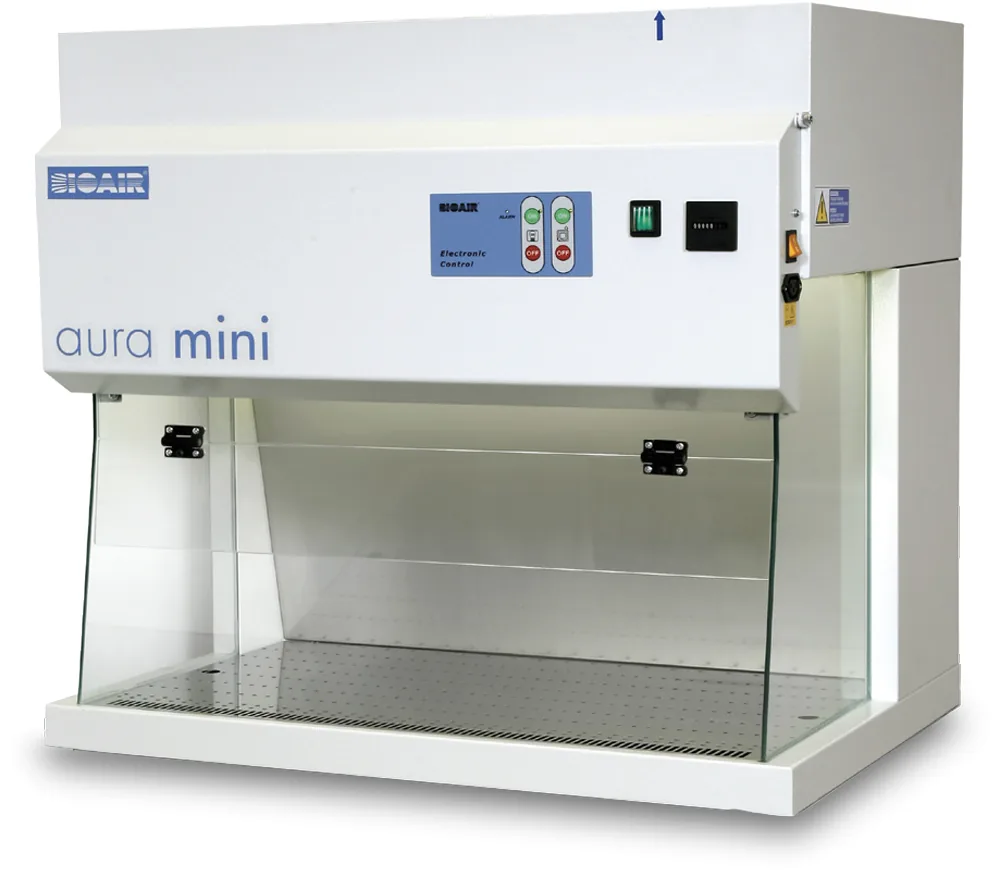
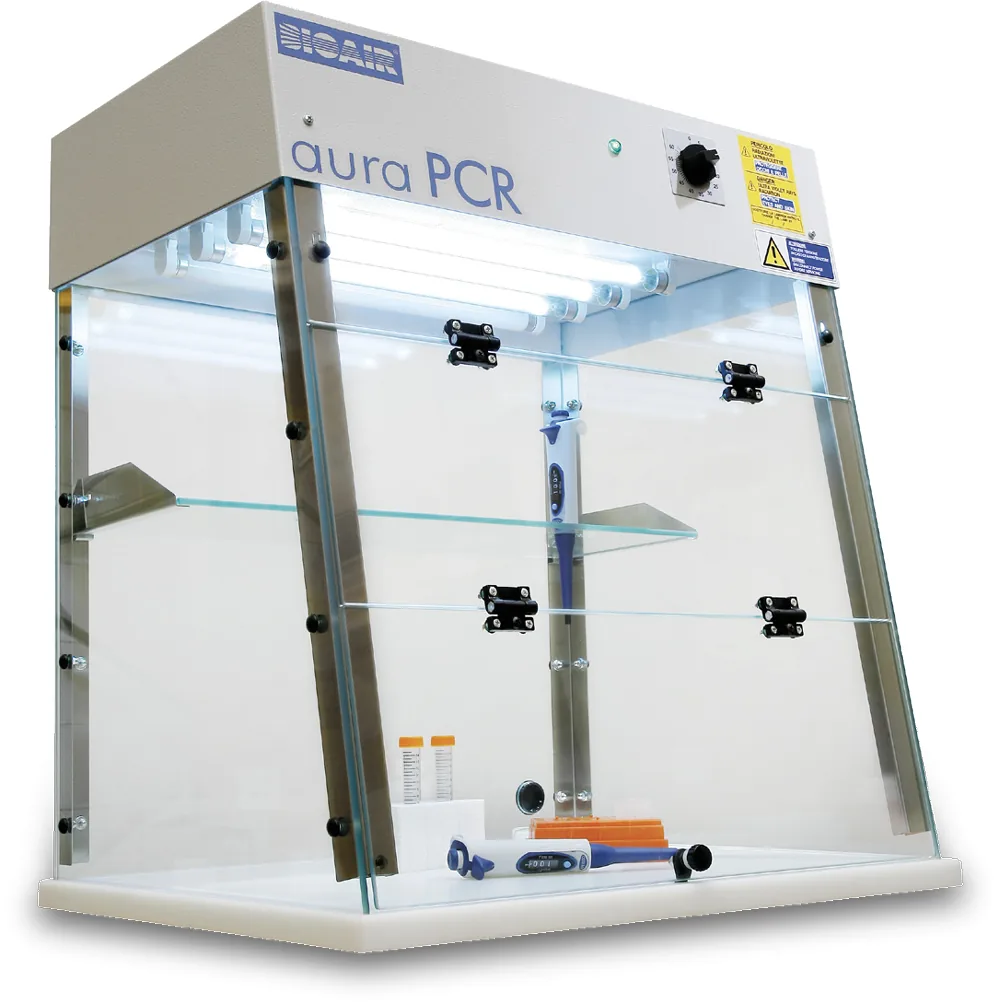
Aura PCR — main photograph
BioAirAvailability: Supplied to order

Aura PCR

Reference aura-pcr

These state-of-the-art PCR cabinets are specially designed for pre- amplification sample preparation in controlled environment in order to prevent DNA carry-over. Any aerosol generated during the handling of the post amplification samples cannot enter the cupboard; any molecule of DNA herein contained is subsequently neutralised with the help of UV radiations.

Request a service for this equipment

Nothing is charged online. Every request is reviewed by an AxiTech engineer before you receive a quotation.

At a glance

Reference
aura-pcr
Category
Biosafety Cabinets & Laminar Flow
Product range
DNA cross-contamination control enclosure

Features

  • Passive PCR enclosure (non ventilated)
  • Fluorescent light turns on automatically when opening the front glass or when UV lights turn off (user selectable)
  • Digital timer for UV lights with memory of the last setpoint
  • 100% UV-safe
  • Front glass divided in three hinged sectors
  • Internal foldable shelf in glass
  • Working surface in chemical resistant polyethylene
Service coverage

AxiTech maintains, repairs and supplies this equipment for hospitals, clinics, laboratories and imaging centres.

Maintenance contracts for BioAir Aura PCR

A service visit on the BioAir Aura PCR covers airflow measurement — inflow and downflow velocities — HEPA filter integrity testing, alarm and interlock checks, and the lighting, UV lamp and electrical safety, following the standard the cabinet is certified to.

Every visit includes calibration and performance verification, and closes with a documented maintenance report you can present during an accreditation audit. Spare-parts availability and a guaranteed response time are written into the contract, so a breakdown never leaves a department waiting for an answer.

Containment and clean-air cabinets like the BioAir Aura PCR are tested at installation, after they are moved or have a filter changed, and at least once a year — the interval NSF/ANSI 49 and EN 12469 set for biosafety cabinets and the usual practice for clean benches and fume hoods.

  • Inflow and downflow velocities measured against the rated values
  • HEPA filter integrity (leak) test
  • Airflow alarms, interlocks and sash checked
  • Lighting, UV lamp and electrical safety tested

Discover our maintenance contracts

Planned preventive maintenance and calibration under contract

Troubleshooting and repair for BioAir Aura PCR

When BioAir Aura PCR fails, our engineers start with a structured diagnostic: error codes, electrical and mechanical checks, and a functional test against the equipment’s own specification. That tells us whether the fault is a consumable, a worn part or a board-level failure before any part is ordered.

Straightforward faults are repaired on site so the department loses as little time as possible. Anything that needs a workbench, a full strip-down or a specialised spare part goes to our workshop and comes back only after a complete post-repair test and, where the equipment requires it, recalibration.

Faults we see most often on this type of equipment

On containment cabinets the recurring faults are loaded or damaged HEPA filters, airflow that has drifted out of range, failed airflow alarms, and motor or blower problems.

Discover our troubleshooting and repair service

Diagnostics, corrective repair and spare parts in the workshop
Troubleshooting

How to troubleshoot BioAir Aura PCR

Work through these checks before you escalate. They are the same first-line sequence our biomedical engineers run on arrival, and they either clear the fault or narrow it down enough that the intervention starts with the right spare part in the van.

  1. Capture the fault before you touch anything: write down the exact error code or message, the serial number from the rating plate, what the operator was doing and whether the fault clears on a restart.

  2. Check that the sash or front window is at its working height and that the front grille is not blocked by paper, equipment or forearms.

  3. Read the airflow display or alarm: a low-airflow alarm right after start-up usually means blocked grilles or a loaded filter.

  4. Keep the work zone clear and let the cabinet run for its purge time before starting work; if the alarm persists, stop work and have the airflow measured.

  5. If the fault is still there, escalate with the evidence. Send AxiTech the model, serial number, error code and the checks you have already run, and an engineer will come back with a diagnosis, a repair quote and a spare-parts lead time for BioAir Aura PCR.

What to send us when you report the fault

  • Manufacturer, model and serial number, from the rating plate
  • The exact error code or message, and the screen it appears on
  • When the fault started, how often it occurs and what triggers it
  • A photograph of the display or of the fault, and the last maintenance report

If the fault survives all five steps, stop using BioAir Aura PCR and open a repair request. Continuing to run equipment through a fault it cannot clear turns a component failure into a board-level one, and on devices used for diagnosis or therapy it puts the result — and the patient — in doubt.

Discover our troubleshooting and repair service

Buying and installing BioAir Aura PCR

AxiTech supplies BioAir Aura PCR together with the accessories and consumables it needs to enter service. We handle importation, delivery and installation, then commission the equipment on site so that it is verified against its specification before the first patient or the first sample.

Installation is followed by training for the users and for your biomedical team, warranty registration, and — if you want it — a maintenance contract that takes over the day the warranty ends, so the equipment never spends a period without planned service.

Discover our equipment sales service

Delivery, installation, commissioning and user training
Product FAQ

Questions about the BioAir Aura PCR

These state-of-the-art PCR cabinets are specially designed for pre- amplification sample preparation in controlled environment in order to prevent DNA carry-over.

Other BioAir equipment we supply, install and maintain.