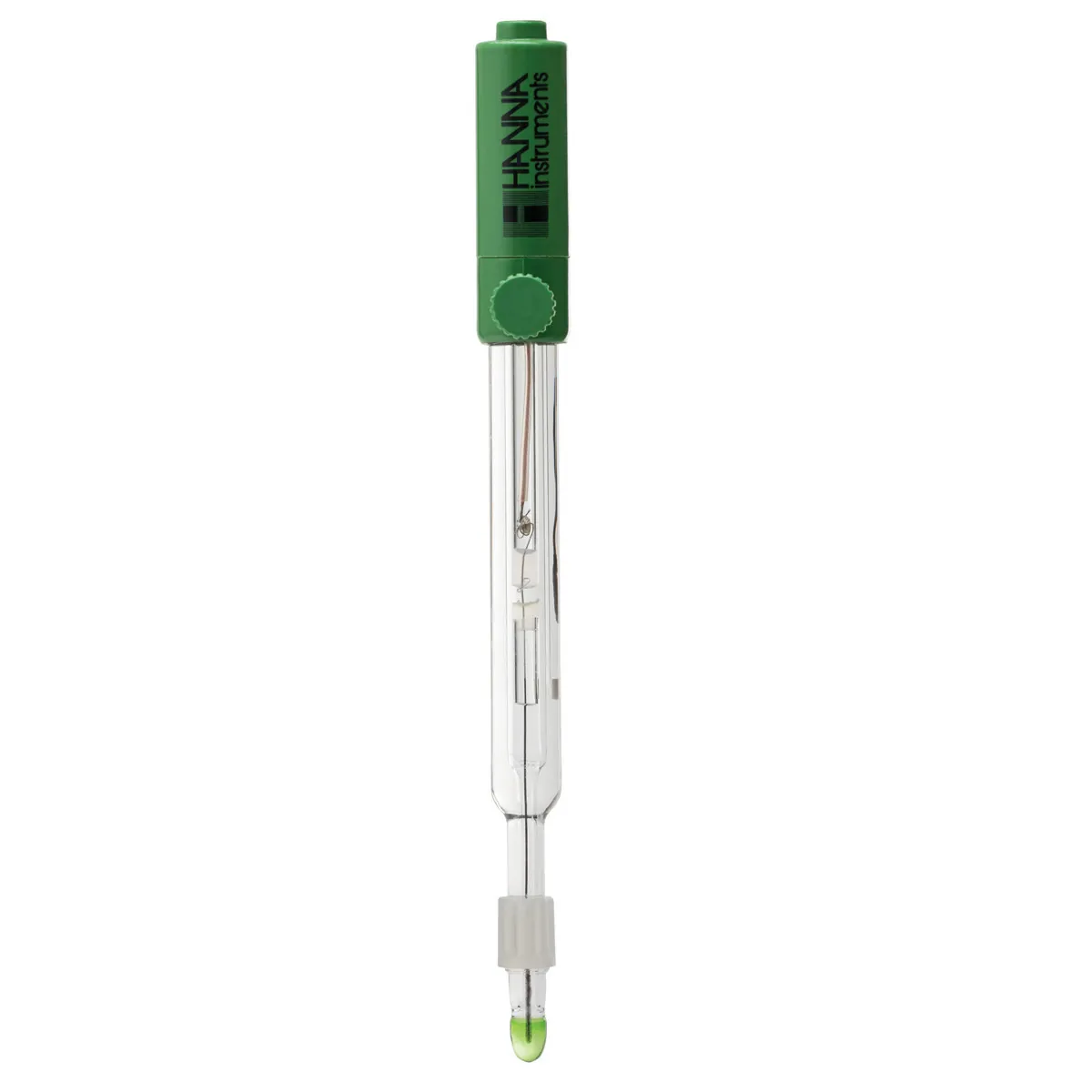
pH Electrode with Clogging Prevention System (CPS) and BNC Connector — main photograph
Hanna InstrumentsAvailability: Supplied to order

pH Electrode with Clogging Prevention System (CPS) and BNC Connector

Reference HI1048B

The HI1048B is a glass body, refillable, sleeve junction pH electrode with a BNC connector. This electrode features a double junction reference, Hanna's Clogging Prevention System (CPS) technology and spherical glass sensing bulb made with general purpose glass. This pH electrode is ideal for wine must and juice due to their high solids content that would clog a standard general purpose pH electrode.

Request a service for this equipment

Nothing is charged online. Every request is reviewed by an AxiTech engineer before you receive a quotation.

At a glance

Reference
HI1048B
Category
pH, Conductivity & Water Analysis
Equipment family
Industry/Industrial, Industry/Water, Industry/Laboratory, Industry/Food, Industry/Beverage, Industry/Beverage/Wine, Industry/Laboratory/Education, Product/Accessories, Product/Accessories/Electrodes a

Overview

The HI1048B is a glass body, refillable, sleeve junction pH electrode with a BNC connector. This electrode features a double junction reference, Hanna's Clogging Prevention System (CPS) technology and spherical glass sensing bulb made with general purpose glass. This pH electrode is ideal for wine must and juice due to their high solids content that would clog a standard general purpose pH electrode.

Maintenance contract — AxiTech provides planned preventive maintenance for pH Electrode with Clogging Prevention System (CPS) and BNC Connector from Hanna Instruments: scheduled visits, safety checks, periodic calibration and a documented service report, backed by a contractual response time.

Troubleshooting, repair and spare parts — our ph, conductivity & water analysis engineers diagnose and repair pH Electrode with Clogging Prevention System (CPS) and BNC Connector on site or in the workshop, fit genuine spare parts and recommission the equipment after performance verification.

Features

  • Clogging Prevention System (CPS™) Technology
  • Refillable Electrode
  • Double Junction Design

Technical specifications

Specifications
SKU
HI1048B Description pH electrode with CPS™ (Clogging Prevention System) Reference double, Ag/AgCl Junction / Flow Rate CPSTM Electrolyte KCl 3.5M Max Pressure 0.1 bar Range pH: 0 to 12 Recommended Operating Temperature -5 to 60°C (23 to 140°F) - LT Tip / Shape dome (dia: 8 mm) Temperature Sensor DIN model only Amplifier DIN model only Body Material glass Cable 7-pole 1 m (3.3') Recommended Use wine, must, juice Connection BNC

Cable
7-pole 1 m (3.3') Recommended Use wine, must, juice Connection BNC
Range
pH: 0 to 12 Recommended Operating Temperature -5 to 60°C (23 to 140°F) - LT Tip / Shape dome (dia: 8 mm) Temperature Sensor DIN model only Amplifier DIN model only Body Material glass Cable 7-pole 1 m (3.3') Recommended Use wine, must, juice Connection BNC
Amplifier
DIN model only Body Material glass Cable 7-pole 1 m (3.3') Recommended Use wine, must, juice Connection BNC

Reference
double, Ag/AgCl Junction / Flow Rate CPSTM Electrolyte KCl 3.5M Max Pressure 0.1 bar Range pH: 0 to 12 Recommended Operating Temperature -5 to 60°C (23 to 140°F) - LT Tip / Shape dome (dia: 8 mm) Temperature Sensor DIN model only Amplifier DIN model only Body Material glass Cable 7-pole 1 m (3.3') Recommended Use wine, must, juice Connection BNC
Connection
BNC
Description
pH electrode with CPS™ (Clogging Prevention System) Reference double, Ag/AgCl Junction / Flow Rate CPSTM Electrolyte KCl 3.5M Max Pressure 0.1 bar Range pH: 0 to 12 Recommended Operating Temperature -5 to 60°C (23 to 140°F) - LT Tip / Shape dome (dia: 8 mm) Temperature Sensor DIN model only Amplifier DIN model only Body Material glass Cable 7-pole 1 m (3.3') Recommended Use wine, must, juice Connection BNC
Electrolyte
KCl 3.5M Max Pressure 0.1 bar Range pH: 0 to 12 Recommended Operating Temperature -5 to 60°C (23 to 140°F) - LT Tip / Shape dome (dia: 8 mm) Temperature Sensor DIN model only Amplifier DIN model only Body Material glass Cable 7-pole 1 m (3.3') Recommended Use wine, must, juice Connection BNC
Tip / Shape
dome (dia: 8 mm) Temperature Sensor DIN model only Amplifier DIN model only Body Material glass Cable 7-pole 1 m (3.3') Recommended Use wine, must, juice Connection BNC
Max Pressure
0.1 bar Range pH: 0 to 12 Recommended Operating Temperature -5 to 60°C (23 to 140°F) - LT Tip / Shape dome (dia: 8 mm) Temperature Sensor DIN model only Amplifier DIN model only Body Material glass Cable 7-pole 1 m (3.3') Recommended Use wine, must, juice Connection BNC

Body Material
glass Cable 7-pole 1 m (3.3') Recommended Use wine, must, juice Connection BNC
Recommended Use
wine, must, juice Connection BNC
Temperature Sensor
DIN model only Amplifier DIN model only Body Material glass Cable 7-pole 1 m (3.3') Recommended Use wine, must, juice Connection BNC
Junction / Flow Rate
CPSTM Electrolyte KCl 3.5M Max Pressure 0.1 bar Range pH: 0 to 12 Recommended Operating Temperature -5 to 60°C (23 to 140°F) - LT Tip / Shape dome (dia: 8 mm) Temperature Sensor DIN model only Amplifier DIN model only Body Material glass Cable 7-pole 1 m (3.3') Recommended Use wine, must, juice Connection BNC
Recommended Operating Temperature
-5 to 60°C (23 to 140°F) - LT Tip / Shape dome (dia: 8 mm) Temperature Sensor DIN model only Amplifier DIN model only Body Material glass Cable 7-pole 1 m (3.3') Recommended Use wine, must, juice Connection BNC
Service coverage

AxiTech maintains, repairs and supplies this equipment for hospitals, clinics, laboratories and imaging centres.

Maintenance contracts for pH Electrode with Clogging Prevention System (CPS) and BNC Connector

AxiTech provides preventive maintenance contracts for pH Electrode with Clogging Prevention System (CPS) and BNC Connector. Each contract fixes a schedule of planned visits in which our biomedical engineers inspect the equipment, replace wear parts before they fail, and verify that it still performs inside the manufacturer’s tolerances.

Every visit includes calibration and performance verification, and closes with a documented maintenance report you can present during an accreditation audit. Spare-parts availability and a guaranteed response time are written into the contract, so a breakdown never leaves a department waiting for an answer.

Laboratory analysers are usually maintained every three to six months, with calibration and quality-control verification at each visit so that results stay traceable.

  • Planned preventive maintenance visits at a fixed interval
  • Calibration and performance verification against the manufacturer’s specifications
  • A documented maintenance report after every intervention
  • Guaranteed availability of spare parts and consumables
  • A contractual response time when the equipment fails

Discover our maintenance contracts

Planned preventive maintenance and calibration under contract

Troubleshooting and repair for pH Electrode with Clogging Prevention System (CPS) and BNC Connector

When pH Electrode with Clogging Prevention System (CPS) and BNC Connector fails, our engineers start with a structured diagnostic: error codes, electrical and mechanical checks, and a functional test against the equipment’s own specification. That tells us whether the fault is a consumable, a worn part or a board-level failure before any part is ordered.

Straightforward faults are repaired on site so the department loses as little time as possible. Anything that needs a workbench, a full strip-down or a specialised spare part goes to our workshop and comes back only after a complete post-repair test and, where the equipment requires it, recalibration.

Faults we see most often on this type of equipment

On analysers most faults come from the fluidics — blocked probes, worn pumps and tubing, leaking valves — followed by optical drift and reagent-handling errors.

Discover our troubleshooting and repair service

Diagnostics, corrective repair and spare parts in the workshop
Troubleshooting

How to troubleshoot pH Electrode with Clogging Prevention System (CPS) and BNC Connector

Work through these checks before you escalate. They are the same first-line sequence our biomedical engineers run on arrival, and they either clear the fault or narrow it down enough that the intervention starts with the right spare part in the van.

  1. Capture the fault before you touch anything: write down the exact error code or message, the serial number from the rating plate, what the operator was doing and whether the fault clears on a restart.

  2. Review the quality-control and calibration history. A result that has drifted across several runs points at calibration or reagents; a sudden shift almost always points at the fluidics.

  3. Inspect the fluid path — probe, tubing, pump, valves and waste line — for blockage, crystallisation or leaks, and confirm reagent and wash levels together with their expiry dates.

  4. Confirm the ambient conditions the method depends on: bench temperature, ventilation, a level and vibration-free surface, and a stable mains supply.

  5. If the fault is still there, escalate with the evidence. Send AxiTech the model, serial number, error code and the checks you have already run, and an engineer will come back with a diagnosis, a repair quote and a spare-parts lead time for pH Electrode with Clogging Prevention System (CPS) and BNC Connector.

What to send us when you report the fault

  • Manufacturer, model and serial number, from the rating plate
  • The exact error code or message, and the screen it appears on
  • When the fault started, how often it occurs and what triggers it
  • A photograph of the display or of the fault, and the last maintenance report

If the fault survives all five steps, stop using pH Electrode with Clogging Prevention System (CPS) and BNC Connector and open a repair request. Continuing to run equipment through a fault it cannot clear turns a component failure into a board-level one, and on devices used for diagnosis or therapy it puts the result — and the patient — in doubt.

Discover our troubleshooting and repair service

Buying and installing pH Electrode with Clogging Prevention System (CPS) and BNC Connector

AxiTech supplies pH Electrode with Clogging Prevention System (CPS) and BNC Connector together with the accessories and consumables it needs to enter service. We handle importation, delivery and installation, then commission the equipment on site so that it is verified against its specification before the first patient or the first sample.

Installation is followed by training for the users and for your biomedical team, warranty registration, and — if you want it — a maintenance contract that takes over the day the warranty ends, so the equipment never spends a period without planned service.

Discover our equipment sales service

Delivery, installation, commissioning and user training
Questions we are asked

Frequently asked questions about Hanna Instruments pH Electrode with Clogging Prevention System (CPS) and BNC Connector

Yes. AxiTech services pH Electrode with Clogging Prevention System (CPS) and BNC Connector, either under a maintenance contract or as a one-off intervention. Our biomedical engineers cover preventive maintenance, calibration, corrective repair and spare-parts supply for this equipment.